Is There A Fix For Medicaid Caregiver Health Decline?
So caregiver health decline may just be the most underappreciated public health problem in America, but there may just be a fix…and no, it’s not AI.
For background, nearly the entire population is affected in some way, but the problem is most pronounced when unpaid caregivers are needed in two places - at work to keep a paycheck coming in, and at home helping a Medicaid beneficiary needing long term support. Their role is essential to keep people out of hospitals, but it’s underappreciated.
In our study alongside Elevance Health’s Public Policy Institute this year, we were asked to reach caregivers for the Medicaid population—people still working jobs but unpaid for caregiving, working out of necessity, stretched thin, stressed out, and gaining weight, unhealthy habits and sometimes addictions. 61% said they are either drinking too much or eating the wrong things, usually both. They are doing the best they can juggling, but caregiving has taken a toll. It’s caused an unfortunate irony for the country - caregivers just trying to lend a hand ending up needing their own long term care, sometimes hospitalized, sicker and in some cases dying.
Most folks in the U.S.—as much as ~60% according to some estimates—do not have the ability to give up work to be with a frail, aging parent, or a disabled family member or friend.
So Can Policy Shift Behavior To Help Them?
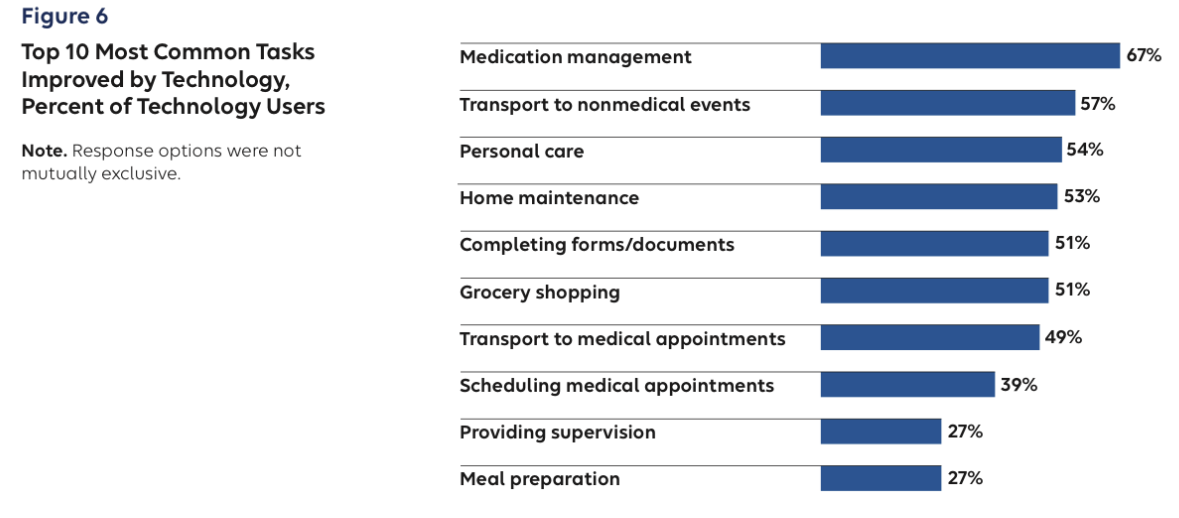
To Elevance's credit, the study was intended to highlight where health policy ought to consider investing to support unpaid caregivers whose health is declining. Of the 2,041 adult caregivers we interviewed, 92% are working--many in healthcare jobs, most full time, all untrained or unprepared for the caregiver's life...where it can be lonely, frustrating, unhealthy. This study, led by BRG using The Behavioral Health Hour readership, did what others have not — it examined caregiver experience and perception with five technology solutions like remote caregiving tools and wearables, but through the lens of those least able to afford them, and least able to leave their jobs. It sought to gauge if Medicaid programs could strengthen caregiver support and perhaps in the process lower morbidity and mortality through tech-enabled tools…
Source: Elevance Health Policy Institute
The Sanchez Effect
“Until I was using the remote system, I was a mess,” Victoria Sanchez, 39, said of her own health taking care of her aunt and mom. “I wasn’t sleeping, I was drinking too much wine, and I was losing my position at work.” Sanchez, a surgical assistant for a medical practice in Massachusetts, was passed over for a promotion and found herself spending time at work worrying about mom, dealing with their questions. The practice itself liked Sanchez but found itself scrambling to hire temporary assistants, in some cases canceling surgeries and in one case dealing with a complication from a temp’s surgical mistake.
Sanchez’s stress from caregiving was creating a ripple effect. But in 2025, she was given a gift from the practice - a $300 monthly stipend to pay for a remote caregiving system, and soon her stress started to drop.
Unlike Sanchez, Angela Foster, an RN, ran a home care company until one day in 2024 when she chose to leave after her dad fell again. "It wasn't planned - I just needed to stop after another hospitalization. I was getting more stressed, dealing with panic attacks for the first time. I even had to go to the hospital….I realized I needed to be there for him all the time."
Foster was lucky. She had the choice Sanchez did not. She had savings from her business to be able to leave and help her dad. “I was fortunate - I know many of the home care aides have to juggle work and caregiving.”
Her departure is another layer to the caregiver health decline - the growing number of people at the top of their field—CEOs of eating disorder programs, nursing directors for skilled nursing facilities, business managers of healthy food delivery services—telling me they are hanging it up, not because they are tired or unmotivated, but because of circumstance connected to caregiving. These executives have spent a lifetime growing a career and a company...only to realize their mom or dad need them more.
Caregiving Gone Sideways
…As a caregiver myself, I tend to resist technology like it’s the plague. Like that time I tried to install a sound system in the bathroom as a safety measure so that dad, 84, wouldn’t keep going into the shower with his hearing aides, only I did it so wrong that somehow it triggered 911 and the firetrucks and police showed up. “BRY!,” my dad texted classically in ALL CAPS, “IM APPARENTLY UNDER INVESTIGATION FOR TAKING A SHOWER - WHAT DID YOU INSTALL?” My wife correctly said, “you’ve just lost your privileges.”
Technology doesn’t always work, it takes time and patience and sometimes skill but for most caregivers it can be a saving grace, having eyes on the folks and using things like monitors and induction stovetops (that someone else installs)—things to keep them safe just long enough so they can tell me another story about what it was like buying penny candy in the 1950s.
Policy Potential
…But for those in our society without the means to choose between dad and a day job, without that luxury—those juggling best they can to help mom or dad but declining themselves from the rigor of caregiving—are we falling short in our policy and in our investment? Are we missing the big picture and failing to make it easier for these caregivers? The short answer is of course we are.
But what if we think differently:
Could we shift more funding to support these caregivers in need and, if we do it right, could it work to bend the cost curve and stop the decline of caregiver health?
Does the technology need improvement? The study suggests so, but there’s also enough evidence it works and helps to resurrect caregiver health.
Could it elevate the health and economic situation for those in the most need, many of whom are working themselves on healthcare’s frontlines, as aides and social workers and companionship for people we care about?
Could it indirectly boost the economy to help the Victoria Sanchez’s among us have peace of mind and less stress?
Isn't that ironic. Many of the hard working people who need our help, who need policymakers to step up, are oft times the same ones critical to healthcare, caring for those we love.
The full study, highlighted here, was a collaborative effort between Elevance Health’s Public Policy Institute, BRG’s health policy group, and The Behavioral Health Hour. Reach out to me here with any inquiries or questions.