The Science Of Sportsmanship
Jannik Sinner ran over the net to help Sasha Zverev up after the player fell on the Wimbledon grass during their final match in England earlier this month. Sinner’s sportsmanship is not uncommon in tennis, nor is it uncommon in sports - at the pro level players compete, but in most — hockey, basketball, tennis, and golf - the players congratulate each other after the game. Hockey is perhaps the most interesting because the players actually fight during the games only to line up broken teeth and all and shake hands. Hockey players even have a penalty called “unsportsmanlike conduct” - they know it’s part of the game. Basketball’s post game sportsmanship hand shakes seem almost too congratulatory if you ask me, and almost as though the players really love each other, many having been friends and comrades growing up in AAU ball. I sorta miss the days of no handshakes after NBA series in the 80s and 90s. It was pure theatre. Isaiah Thomas once walked off the court after Jordan’s Bulls finally bested his Pistons. A few years later, Christian Laettner, lauded as maybe the greatest college ball payer ever, stepped on several players in Duke’s march to the finals. But there’s context here - Laettner getting harrassed for his perfect hair, Thomas perhaps for losing the mantle to Jordan, marking an end to his run. We can’t really have so much outrage when athletes are unsportsmanlike in these moments, can we? Many did with the World Cup final after Argentina’s loss to Spain. It seems things could have been handled better but when millions watch and the players feel the pressure of a nation, the tension and agony of defeat after coming so close has to be released in some way, no? Golfers appear to be boast the most sportsmanship in part because it’s embedded in the rules. Pro golfers rarely argue and sometimes they even tell the officials or playing partners when their ball accidentally moves, forcing a penalty on them. Dustin Johnson had to do that in what I believe was the PGA Championship years ago - costing him the tournament. That is sportsmanship in its purest form. Bryson DeChambeu’s penalty at the Open this past weekend fueled questions about sportsmanship after officials thought he tried to cheat. Some players tactfully came to the golfer’s defense, like US player Scottie Sheffler who said he’d never seen or suspected any cheating from Bryson, that maybe he and other golfers could be more careful when they hit their ball wayward into the bushes, but overall, it’s hard when the camera is catching everything. It’s not your average Sunday morning foresome with the boys, when you can basically kick your ball into the fairway - you only need to live with your decision. Not that I’ve ever done that. Tennis has had its unsportsmanlike moments - a decade of McEnroe yelling, Kyrigos screaming, but often from their own disagreement with the officials, not the game or their opponent. Sinner’s act was perhaps not surprising if you’ve watched the world #1, but it was, I suppose, striking to see a player mid match break with tradition—it would be like a ball player going over to the other dugout. It is interesting this happened just a year after the sport suspended Sinner for taking an illegal cream that purportedly helped him with healing. He paid a price back then, missing several tournaments and losing some fans. Some players questioned Sinner’s motives, but most acknowledged it happened and to move on. Sinner has maintained he didn’t know the cream had an banned substance, but ultimately has carried himself the same on the court before and after that suspension. He is gracious when he wins easily, and in the rare moments he loses he doesn’t scream or run - he accepts. His quick reaction to Zverev’s fall was just instinct from my perspective. That is really the lesson to me - he didn’t think much in the moment, just reacted as though he’d want others to do the same for him. Be gracious, give a hand, show kindness amidst what is a competition. Perhaps there’s a gamesmanship in all this I’m underappreciating. I doubt it. Most teens who watch sports believe sportsmanship is very important - 77% say they believe it is very important, 15% important, the balance say it isn’t as important as their parents and coaches make it seem, which is interesting and perhaps not wrong. Sportsmanship usually comes from just who the player is as a person and perhaps how they are raised. And the more we have of it in sports the better - there’s always time between the lines and while the clock is running to play selfishly and throw some punches even as I did when I was 17 in that varsity hoops game vs EO Smith high school. In hindsight I probably shouldn’t have done it but I was 5’4” guarding a 6’2”” player about to dunk on me. It was desperation, tactical and I suppose unsportsmanlike. But we move on. Even though the player I punched in the nads didn’t move on, least not right away. The beauty is I wasn’t called for a foul despite the other team’s complaints. And let’s face it, sport doesn’t need to decide between sportsmanship and unsportsmanlike behavior—there’s room for both.
For a look at the moment, click here.
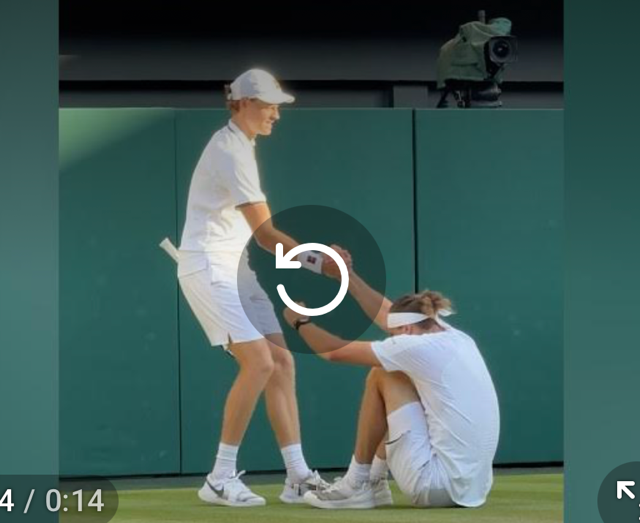
Source: Wimbledon Tennis Finals